




An International Journal

ISSN: 2582-0818

Online Articles: 242

Home 9 Journals 9 ACM Home

Table of Content

Recent Publish Articles

Article

Article

Article

Article

Article

ACM Home

The Annals of Communications in Mathematics (ACM) is an international, interdisciplinary, open-access journal which provides an advanced forum for studies related to mathematical sciences that has been fully refereed since 2018. It devotes exclusively to the publication of high-quality reviews, regular research papers and short communications in all areas of Pure and Applied Mathematics. ACM also publishes timely and thorough survey articles on current trends, new theoretical techniques, novel ideas, and new Mathematical tools in different branches of Mathematics.

Editorial office e-mail: editor@technoskypub.com

Editor-in-Chief: G. Muhiuddin, University of Tabuk, KSA

Article Processing Charge

There is no article processing or publication charges. The journal is free for both authors and readers.

Open Access Article

Gödel’s Incompleteness Theorems Demystified: A Rigorous Formal–Metamathematical Exposition and Its Philosophical Limits

Aliefya Mahalva Ayn

Annals of Communications in Mathematics 2026

, 9(2)

, 16

DOI: https://doi.org/10.62072/acm.2026.09032

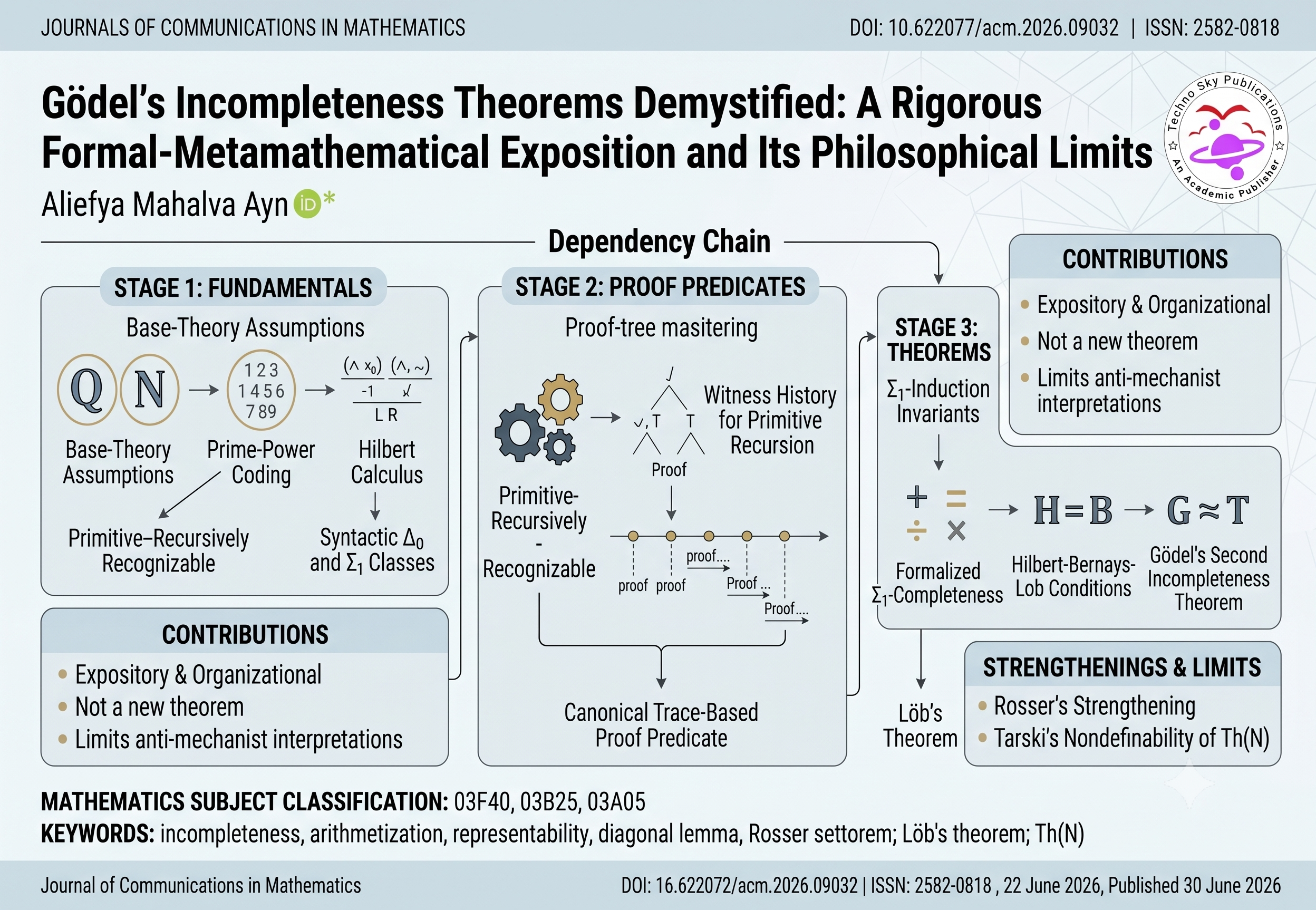
Abstract:This article assembles a detailed paper-level dependency chain for Gödel’s First and Second Incompleteness Theorems while identifying the effectiveness, consistency, and base-theory assumptions used at each stage. It separates computable enumerability from primitive-recursive axiomatizability; develops Gödel-style prime-power coding; fixes an explicit Hilbert calculus; gives capture-avoiding substitution with separate primitive-recursive majorants depending on all relevant variable indices; and proves primitive recursiveness of witness-annotated proof verification for a merely computably enumerable axiom set. The syntactic \( \Delta_0 \) and \( \Sigma_1 \) classes are fixed effectively, making the induction axioms of \( I\Sigma_1 \) primitive-recursively recognizable. The representability theorem is proved in \( Q \) by structural induction, using a finite-unfolding lemma, explicit \( \Sigma_1 \) closure under composition, and a displayed witness history for primitive recursion. For provability theory, the article defines a canonical trace-based proof predicate and gives detailed construction schemas, with explicit \( \Sigma_1 \)-induction invariants, for proof transformations and bounded proof synthesis in \( I\Sigma_1 \). These yield formalized \( \Sigma_1 \)-completeness, the Hilbert–Bernays–Löb derivability conditions, Löb’s theorem, and the Second Incompleteness Theorem. The article also proves Rosser’s strengthening, states Tarski’s theorem as the nondefinability of \( \mathrm{Th}(\mathbb{N}) \) in arithmetic, and marks the limits of anti-mechanist interpretations. Its contribution is expository and organizational rather than a new incompleteness theorem.
⬇ Download PDF (6)
Open Access Article

The Power Reduced Kies Distribution: Theory and Applications in Environmental, Insurance and Health Sciences

Ehinomen Emmanuel Ehizojie

Annals of Communications in Mathematics 2026

, 9(2)

, 15

DOI: https://doi.org/10.62072/acm.2026.09031

Abstract:The adequacy of a statistical model ultimately rests on how faithfully the chosen distribution captures the structural features of the data at hand, including skewness, kurtosis, multi-modality, and the shape of the HRF. Consequently, the construction of new and more flexible distributions remains an active and consequential area of statistical research. In the same vein, this study introduces the Power Reduced Kies distribution (PRKD), a new two-parameter bounded distribution obtained through the power transformation of random variable of the Reduced Kies distribution. The inclusion of the power parameter endows the PRKD with a substantially richer variety of density shapes, including decreasing, right-skewed, left-skewed, reversed-J, and approximately symmetric forms, as well as a wider range of hazard rate behaviours, including increasing and bathtub-shaped forms, none of which can be collectively achieved by the single-parameter Reduced Kies distribution. Several important statistical properties of the PRKD are derived, including its linear representation, reliability characteristics, quantile function, moments, moment generating function, mode, and order statistics. The model parameters are estimated using the maximum likelihood and maximum product of spacings methods. A Monte Carlo simulation study is conducted to examine the finite-sample performance of the estimators under different parameter settings and sample sizes using mean estimates and mean squared errors. The results indicate that both estimators perform satisfactorily, although the maximum product of spacings method generally provides more reliable estimates for smaller sample sizes. The practical applicability of the PRKD is demonstrated using four real datasets from environmental, insurance, and health sciences. Comparative analyses with twelve competing unit distributions reveal that the PRKD provides highly competitive fits according to several model selection criteria and goodness-of-fit measures.
⬇ Download PDF (6)
Open Access Article

Symmetric Jordan Bi-semiderivations on Prime Rings

Damla Yılmaz* and Hasret Yazarli

Annals of Communications in Mathematics 2026

, 9(2)

, 14

DOI: https://doi.org/10.62072/acm.2026.09030

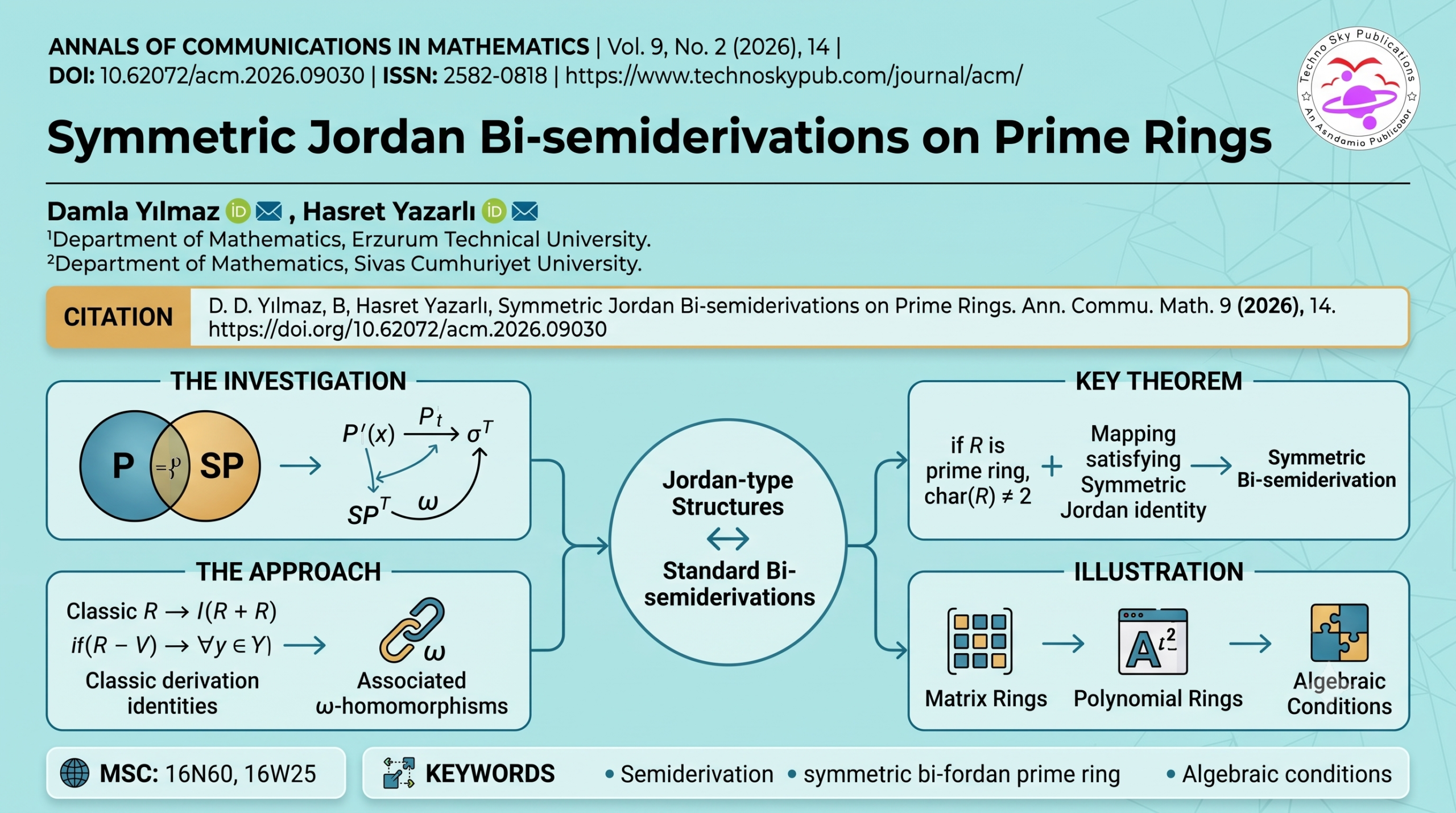
Abstract:In this paper, we investigate the structural properties of symmetric bi-semiderivations in the setting of prime and semiprime rings. By adapting classical derivation identities through the use of associated ω-homomorphisms, we obtain several characterization results that generalize known theorems from derivations to the bi-additive context. Particular attention is given to the interplay between Jordan-type structures and standard bi-semiderivations. In this direction, we prove that if R is a prime ring with char(R) ≠ 2, then every mapping satisfying the symmetric Jordan bi-semiderivation identity is in fact a symmetric bi-semiderivation. To illustrate our results, we present explicit examples constructed from matrix rings and polynomial rings, which also highlight the necessity of the imposed algebraic conditions.
⬇ Download PDF (8)
Open Access Article

On characterizations of general type-2 fuzzy regular grammars and its languages

Shambhu Sharan*, Rakesh Kumar and Nitish Kumar

Annals of Communications in Mathematics 2026

, 9(2)

, 13

DOI: https://doi.org/10.62072/acm.2026.09029

Abstract:The purpose of this paper is to introduce and study the notion of various important forms of general type-2 fuzzy grammars, namely, the general type-2 fuzzy grammar in normal form, general type-2 fuzzy linear grammar, general type-2 fuzzy left linear grammar, and general type-2 fuzzy right linear grammar. We establish that each of these forms is equivalent to a general type-2 fuzzy regular grammar (except for an empty string) in the sense that they induce the same class of general type-2 fuzzy languages. These results not only generalizes classical equivalence theorems from fuzzy grammar theory but also provide a theoretical basis for the analysis and future development of general type-2 fuzzy grammar theory.
⬇ Download PDF (1)
Open Access Article

Grundy Locating-Hop Domination Sequences in Graphs

Samuel John E. Parreno

Annals of Communications in Mathematics 2026

, 9(2)

, 12

DOI: https://doi.org/10.62072/acm.2026.09028

Abstract:Locating-hop domination refines hop domination by requiring vertices outside a hop dominating set to have nonempty and pairwise distinct distance-two signatures. Domination sequences, on the other hand, measure how long domination can be built through legal vertex choices. This paper introduces Grundy locating-hop domination sequences, in which a vertex choice is legal when it either footprints a previously undominated vertex through a closed hop neighborhood or strictly reduces an ambiguity potential that counts indistinguishable outside vertex pairs. The associated invariant is denoted by \( \gamma_{gr}^{\ell h}(G) \). General bounds are established, including \( \gamma_{\ell h}(G) \leq \gamma_{gr}^{\ell h}(G) \leq n(G) \). The parameter is additive over disjoint unions, and a hop-graph reduction identifies \( \gamma_{gr}^{\ell h}(G) \) with the corresponding locating-dominating sequence parameter on the hop graph \( G^{(2)} \). Exact values are obtained for complete graphs and stars. In particular, \( \gamma_{gr}^{\ell h}(K_n) = n \) and \( \gamma_{gr}^{\ell h}(K_{1,n}) = n \) for \( n \geq 2 \). Stars also give an infinite separation family: for \( n \geq 3 \), \( \gamma_{\ell h}(K_{1,n}) = 2 \) while \( \gamma_{gr}^{\ell h}(K_{1,n}) = n \).
⬇ Download PDF (10)
Open Access Article

Permutation-Induced Automorphisms and Non-conjugate Symmetries of the Magma Monoid

Isaac Owusu-Mensah* and Kwame Owusu Bempah

Annals of Communications in Mathematics 2026

, 9(2)

, 11

DOI: https://doi.org/10.62072/acm.2026.09027

Abstract:We study the algebra of all binary operations on a finite set, with composition defined as follows: for two binary operations A and B, their composition at an ordered pair x and y is B applied to the pair consisting of A(x,y) and A(y,x). A canonical family of automorphisms arises by conjugation with permutations of the underlying set. We characterize how these permutation-induced automorphisms act on several natural invariant subsets and show that the permutation they induce on constant operations determines every operation’s values on the diagonal. Beyond conjugation by permutations, we identify additional symmetries that are not conjugate to these permutation conjugations, and we show that conjugation by permutations need not be surjective onto the full automorphism group of the algebra under the given composition. For small underlying sets we obtain complete descriptions: when the set has two elements the automorphism group is isomorphic to the two-element symmetric group, and when the set has three elements it is isomorphic to the direct product of the three-element symmetric group with a cyclic group of order two. The paper concludes with algorithmic remarks and open problems toward a full classification of the automorphism group.
⬇ Download PDF (7)
Open Access Article

Infinitely many Concrete Multiple-Composite and Amplified Fuzzy ordinary and Fractional Neural Network Approximations

George A. Anastassiou

Annals of Communications in Mathematics 2026

, 9(2)

, 10

DOI: https://doi.org/10.62072/acm.2026.09026

Abstract:Here we investigate further the univariate fuzzy ordinary and fractional quantitative approximation of fuzzy real valued functions on a compact interval. This is done by quasi-interpolation sigmoid multicomposite activation functions based infinitely many specific and amplified multicomposite fuzzy neural network operators. These approximations are derived by establishing fuzzy multicomposite Jackson type inequalities involving the fuzzy moduli of continuity of the function, or of the right and left Caputo fuzzy fractional derivatives of the involved function. The approximations are fuzzy pointwise and fuzzy uniform. The related feed-forward fuzzy multicomposite neural networks are with one hidden layer. We study in particular the fuzzy integer derivative and just fuzzy continuous cases. Our fuzzy fractional multicomposite approximation result using higher order fuzzy differentiation converges better than in the multicomposite fuzzy just continuous case. All these approximations are generated by 7 specific and basic activation functions.
⬇ Download PDF (0)
Open Access Article

On Connected Secure Domination Polynomial of Some Graphs

Jason D. Andoyo* and Ricky F. Rulete

Annals of Communications in Mathematics 2026

, 9(2)

, 9

DOI: https://doi.org/10.62072/acm.2026.09025

Abstract:A set \( S \subseteq V(G) \) of the connected graph \( G = (V(G), E(G)) \) is said to be a connected secure dominating set if \( S \) is a dominating set, \( S \) is a secure set, and \( \langle S \rangle_G \) is a connected graph. The connected secure domination polynomial of \( G \) is \( D_s^c(G,x) = \sum_{i=\gamma_s^c(G)}^{n} d_s^c(G,i)x^i \) where \( \gamma_s^c(G) = \min \{|S| : S \text{ is a connected secure dominating set of } G\} \) and \( d_s^c(G,i) \) is the number of connected secure dominating sets with cardinality \( i \). In this paper, we will determine the connected secure domination polynomial of path graph \( P_n \), cycle graph \( C_n \), complete graph \( K_n \), star graph \( K_{1,n} \), and corona graph \( G \circ K_1 \).
⬇ Download PDF (3)
Open Access Article

On Total Product Cordial Labeling of Some Snake Graphs

Rex Ryan A. Marquez and Ariel C. Pedrano*

Annals of Communications in Mathematics 2026

, 9(2)

, 8

DOI: https://doi.org/10.62072/acm.2026.09024

Abstract:A total product cordial labeling of a graph \( G \) is a function \( f : V \rightarrow \{0,1\} \). For each \( xy \), assign the label \( f(x)f(y) \); \( f \) is called total product cordial labeling of \( G \) if it satisfies the condition that \( |v_f(0)+e_f(0)-v_f(1)-e_f(1)| \leq 1 \) where \( v_f(i) \) and \( e_f(i) \) denote the set of vertices and edges which are labeled with \( i = 0,1 \), respectively. A graph with a total product cordial labeling defined on it is called a total product cordial graph. In this paper, we determined the total product cordial labeling of the snake graphs \( T_n \), \( A(T_n) \), \( D(T_n) \), \( DA(T_n) \), \( Q_n \), \( A(Q_n) \), \( D(Q_n) \), and \( DA(Q_n) \).
⬇ Download PDF (19)
Open Access Article

A Study on Quasi-Interior Hyperideals in Hypersemigroups

B. Vineela, M. Murali Krishna Rao, Rajendra Kumar Kona* and Ganesh Kumar Reddi

Annals of Communications in Mathematics 2026

, 9(2)

, 7

DOI: https://doi.org/10.62072/acm.2026.09023

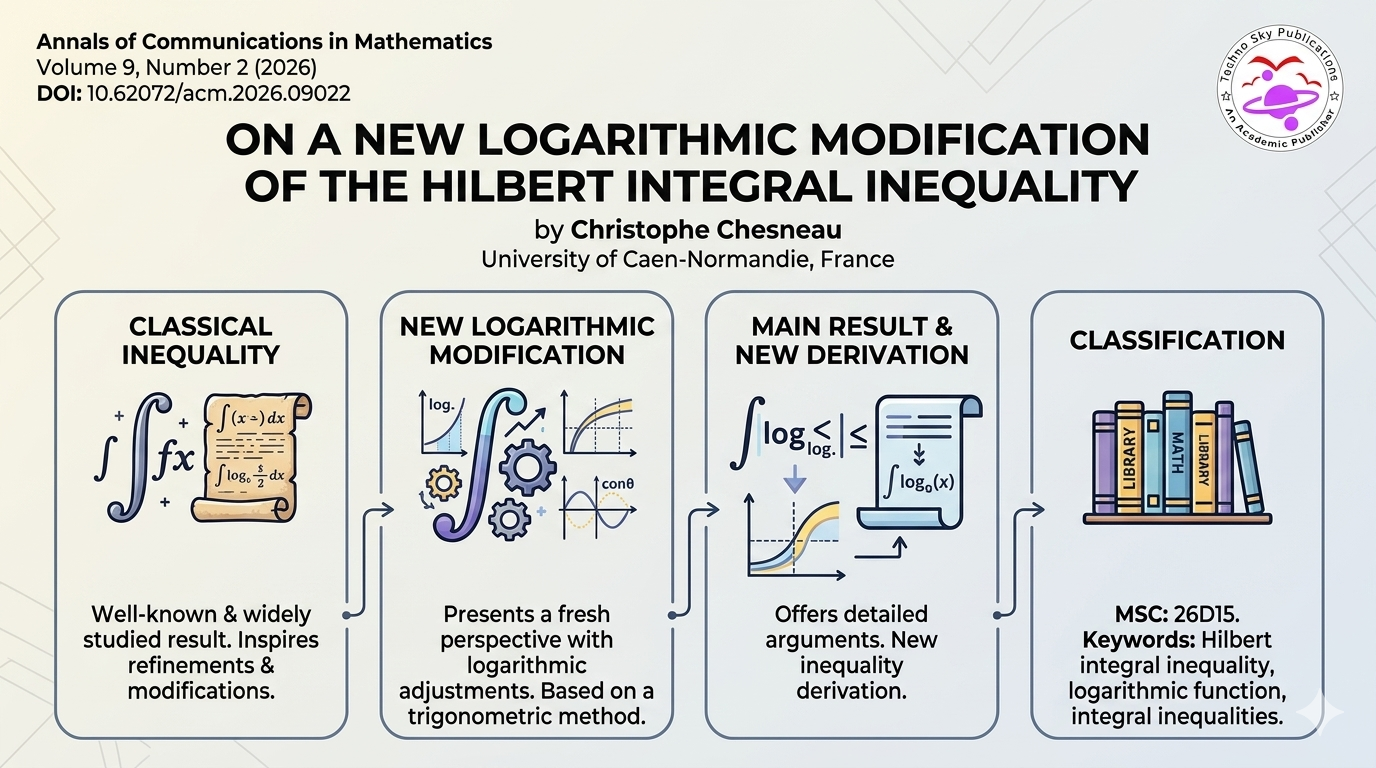
Abstract:The Hilbert integral inequality is a well-known and widely studied result in analysis that has inspired many refinements and modifications. In this paper, we present a new logarithmic modification of this inequality. Our approach is based on a trigonometric method that offers a fresh perspective on existing standard techniques. As a consequence, we also derive another integral inequality. All arguments are presented in full detail.
⬇ Download PDF (18)
Open Access Article

On a new logarithmic modification of the Hilbert integral inequality

Christophe Chesneau

Annals of Communications in Mathematics 2026

, 9(2)

, 6

DOI: https://doi.org/10.62072/acm.2026.09022

Abstract:The Hilbert integral inequality is a well-known and widely studied result in analysis that has inspired many refinements and modifications. In this paper, we present a new logarithmic modification of this inequality. Our approach is based on a trigonometric method that offers a fresh perspective on existing standard techniques. As a consequence, we also derive another integral inequality. All arguments are presented in full detail.
⬇ Download PDF (14)
Open Access Article

Distinguishing Numbers for Cartesian Powers and Wreath Products

Salihu Aliyu Lawan

Annals of Communications in Mathematics 2026

, 9(2)

, 5

DOI: https://doi.org/10.62072/acm.2026.09021

Abstract:The distinguishing number is an important invariant used to measure the extent to which symmetries of graphs and permutation group actions can be broken by vertex labelings. In this paper, we investigate distinguishing labelings arising from permutation group actions with particular emphasis on Cartesian power constructions and wreath product actions. We establish structural bounds for distinguishing numbers in terms of orbit structure, stabilizers, and base size of permutation groups. Furthermore, we analyze the behavior of distinguishing numbers under Cartesian powers of sets and derive bounds for wreath product actions of the form \( G \wr S_m \) acting on \( X^m \). Several examples involving symmetric groups are presented to illustrate the theoretical results. These results contribute to a deeper understanding of symmetry breaking in permutation group actions and provide new insights into the interplay between distinguishing numbers and algebraic structures arising from wreath products.
⬇ Download PDF (14)
Open Access Article

Interior hop Roman dominating function in graphs

Leomarich F. Casinillo

Annals of Communications in Mathematics 2026

, 9(2)

, 4

DOI: https://doi.org/10.62072/acm.2026.09020

Abstract:Let \( G = (V(G), E(G)) \) be a simple non-complete graph and let \( \xi : V \rightarrow \{0,1,2\} \) be a hop Roman dominating function (HRDF) on \( G \). For each \( j \in \{0,1,2\} \), let \( V_j = \{x \in V(G) : \xi(x) = j\} \). Then \( \xi = (V_0, V_1, V_2) \). A function \( \xi \) is an interior hop Roman dominating function (InHRDF) on \( G \) if for each \( v \in V_0 \), there exists \( u \in V_2 \) such that \( d_G(u,v) = 2 \), and either \( V_1 = V(G) \) or for every \( v \in V_2 \), \( v \) is an interior vertex of \( G \). The weight of InHRDF \( \xi \) is denoted by \( \omega_G^{\text{InhR}}(\xi) \) and is defined as \( \omega_G^{\text{InhR}}(\xi) = \sum_{u \in V(G)} \xi(u) = |V_1| + 2|V_2| \).The minimum weight of an InHRDF \( \xi \) on \( G \), denoted as \( \gamma_{\text{InhR}}(G) = \min \{ \omega_G^{\text{InhR}}(\xi) : \xi \text{ is an InHRDF on } G \} \), is called the interior hop Roman domination number. Every InHRDF \( \xi \) on \( G \) satisfying the condition \( \omega_G^{\text{InhR}}(\xi) = \gamma_{\text{InhR}}(G) \) is called a \( \gamma_{\text{InhR}} \)-function on \( G \). In this paper, we investigate a new restricted parameter of a hop Roman dominating function in graphs called the interior hop Roman domination and present some combinatorial results.
⬇ Download PDF (12)
Open Access Article

On Interval-Valued Λ-Sets and 𝜆-Closed Sets via Kernel Operators

I. Rajasekaran* and O. Nethaji

Annals of Communications in Mathematics 2026

, 9(2)

, 3

DOI: https://doi.org/10.62072/acm.2026.09019

Abstract:In this study, we investigate specific kernel structures within interval valued topological spaces. We introduce the notions of interval-valued Λ-sets and interval-valued λ-closed sets and discuss their essential properties. The connections between these concepts and existing notions in interval-valued topology are examined in detail. Various characterizations and foundational results are presented to clarify their structural behavior. This work aims to enhance and extend the theoretical framework of interval-valued topology.
⬇ Download PDF (12)
Open Access Article

Statistical Gauge Convergence and Its Induced Topology in Metric Spaces

İsmail Osmanoğlu

Annals of Communications in Mathematics 2026

, 9(2)

, 2

DOI: https://doi.org/10.62072/acm.2026.09018

Abstract:This paper introduces statistical gauge convergence as a refinement of statistical convergence in metric spaces, where deviations from the limit are controlled by positive continuous functions rather than fixed constants. We provide equivalent density based characterizations and examine their relationship with both classical and statistical convergence, showing that the corresponding implications are strict in general. Further more, we investigate the topology generated by this convergence and prove that it is typically finer than the underlying metric topology. Several examples are included to clarify the hierarchical structure among the considered notions of convergence.
⬇ Download PDF (17)
Open Access Article

Outer-convex Hop Roman Dominating Function in Graphs

Leomarich F. Casinillo

Annals of Communications in Mathematics 2026

, 9(2)

, 1

DOI: https://doi.org/10.62072/acm.2026.09017

Abstract:Let \( G = (V(G), E(G)) \) be a connected graph and let \( f : V(G) \rightarrow \{0,1,2\} \) be a hop Roman dominating function (HRDF) on \( G \). If for each \( k \in \{0,1,2\} \), \( V_k = \{x \in V(G) : f(x) = k\} \), then \( f = (V_0, V_1, V_2) \). A function \( f \) is an outer-convex hop Roman dominating function (OConHRDF) on \( G \) provided that for every \( v \in V_0 \), there exists \( u \in V_2 \) such that \( v \in N_G^2(u) \) and \( V_0 \) is a convex set. The weight of OConHRDF \( f \) on \( G \) is denoted by \( \widetilde{\omega}_G^{conhR}(f) \) and is defined as \( \widetilde{\omega}_G^{conhR}(f) = \sum_{v \in V(G)} f(v) \).The smallest weight of an OConHRDF \( f \) on \( G \), denoted by \( \widetilde{\gamma}_{conhR}(G) \), is called the outer-convex hop Roman domination number, which can be written as \( \widetilde{\gamma}_{conhR}(G) = \min \{ \widetilde{\omega}_G^{conhR}(f) : f \text{ is an OConHRDF on } G \} \). Every OConHRDF \( f \) on \( G \) satisfying the condition \( \widetilde{\omega}_G^{conhR}(f) = \widetilde{\gamma}_{conhR}(G) \) is so-called a \( \widetilde{\gamma}_{conhR} \)-function on \( G \). This paper introduces a new parameter of a hop Roman dominating function in graphs, called outer-convex hop Roman dominating function and presents initial investigation.
⬇ Download PDF (27)

Open AccessArticle

Outer-convex Hop Roman Dominating Function in Graphs

Leomarich F. Casinillo

Annals of Communications in Mathematics 2026

, 9(2)

, 1

DOI: https://doi.org/10.62072/acm.2026.09017

Abstract:Let \( G = (V(G), E(G)) \) be a connected graph and let \( f : V(G) \rightarrow \{0,1,2\} \) be a hop Roman dominating function (HRDF) on \( G \). If for each \( k \in \{0,1,2\} \), \( V_k = \{x \in V(G) : f(x) = k\} \), then \( f = (V_0, V_1, V_2) \). A function \( f \) is an outer-convex hop Roman dominating function (OConHRDF) on \( G \) provided that for every \( v \in V_0 \), there exists \( u \in V_2 \) such that \( v \in N_G^2(u) \) and \( V_0 \) is a convex set. The weight of OConHRDF \( f \) on \( G \) is denoted by \( \widetilde{\omega}_G^{conhR}(f) \) and is defined as \( \widetilde{\omega}_G^{conhR}(f) = \sum_{v \in V(G)} f(v) \).The smallest weight of an OConHRDF \( f \) on \( G \), denoted by \( \widetilde{\gamma}_{conhR}(G) \), is called the outer-convex hop Roman domination number, which can be written as \( \widetilde{\gamma}_{conhR}(G) = \min \{ \widetilde{\omega}_G^{conhR}(f) : f \text{ is an OConHRDF on } G \} \). Every OConHRDF \( f \) on \( G \) satisfying the condition \( \widetilde{\omega}_G^{conhR}(f) = \widetilde{\gamma}_{conhR}(G) \) is so-called a \( \widetilde{\gamma}_{conhR} \)-function on \( G \). This paper introduces a new parameter of a hop Roman dominating function in graphs, called outer-convex hop Roman dominating function and presents initial investigation.
⬇ Download PDF (27)
Open AccessArticle

Statistical Gauge Convergence and Its Induced Topology in Metric Spaces

İsmail Osmanoğlu

Annals of Communications in Mathematics 2026

, 9(2)

, 2

DOI: https://doi.org/10.62072/acm.2026.09018

Abstract:This paper introduces statistical gauge convergence as a refinement of statistical convergence in metric spaces, where deviations from the limit are controlled by positive continuous functions rather than fixed constants. We provide equivalent density based characterizations and examine their relationship with both classical and statistical convergence, showing that the corresponding implications are strict in general. Further more, we investigate the topology generated by this convergence and prove that it is typically finer than the underlying metric topology. Several examples are included to clarify the hierarchical structure among the considered notions of convergence.
⬇ Download PDF (17)
Open AccessArticle

On Interval-Valued Λ-Sets and 𝜆-Closed Sets via Kernel Operators

I. Rajasekaran* and O. Nethaji

Annals of Communications in Mathematics 2026

, 9(2)

, 3

DOI: https://doi.org/10.62072/acm.2026.09019

Abstract:In this study, we investigate specific kernel structures within interval valued topological spaces. We introduce the notions of interval-valued Λ-sets and interval-valued λ-closed sets and discuss their essential properties. The connections between these concepts and existing notions in interval-valued topology are examined in detail. Various characterizations and foundational results are presented to clarify their structural behavior. This work aims to enhance and extend the theoretical framework of interval-valued topology.
⬇ Download PDF (12)
Open AccessArticle

Interior hop Roman dominating function in graphs

Leomarich F. Casinillo

Annals of Communications in Mathematics 2026

, 9(2)

, 4

DOI: https://doi.org/10.62072/acm.2026.09020

Abstract:Let \( G = (V(G), E(G)) \) be a simple non-complete graph and let \( \xi : V \rightarrow \{0,1,2\} \) be a hop Roman dominating function (HRDF) on \( G \). For each \( j \in \{0,1,2\} \), let \( V_j = \{x \in V(G) : \xi(x) = j\} \). Then \( \xi = (V_0, V_1, V_2) \). A function \( \xi \) is an interior hop Roman dominating function (InHRDF) on \( G \) if for each \( v \in V_0 \), there exists \( u \in V_2 \) such that \( d_G(u,v) = 2 \), and either \( V_1 = V(G) \) or for every \( v \in V_2 \), \( v \) is an interior vertex of \( G \). The weight of InHRDF \( \xi \) is denoted by \( \omega_G^{\text{InhR}}(\xi) \) and is defined as \( \omega_G^{\text{InhR}}(\xi) = \sum_{u \in V(G)} \xi(u) = |V_1| + 2|V_2| \).The minimum weight of an InHRDF \( \xi \) on \( G \), denoted as \( \gamma_{\text{InhR}}(G) = \min \{ \omega_G^{\text{InhR}}(\xi) : \xi \text{ is an InHRDF on } G \} \), is called the interior hop Roman domination number. Every InHRDF \( \xi \) on \( G \) satisfying the condition \( \omega_G^{\text{InhR}}(\xi) = \gamma_{\text{InhR}}(G) \) is called a \( \gamma_{\text{InhR}} \)-function on \( G \). In this paper, we investigate a new restricted parameter of a hop Roman dominating function in graphs called the interior hop Roman domination and present some combinatorial results.
⬇ Download PDF (12)
Open AccessArticle

Distinguishing Numbers for Cartesian Powers and Wreath Products

Salihu Aliyu Lawan

Annals of Communications in Mathematics 2026

, 9(2)

, 5

DOI: https://doi.org/10.62072/acm.2026.09021

Abstract:The distinguishing number is an important invariant used to measure the extent to which symmetries of graphs and permutation group actions can be broken by vertex labelings. In this paper, we investigate distinguishing labelings arising from permutation group actions with particular emphasis on Cartesian power constructions and wreath product actions. We establish structural bounds for distinguishing numbers in terms of orbit structure, stabilizers, and base size of permutation groups. Furthermore, we analyze the behavior of distinguishing numbers under Cartesian powers of sets and derive bounds for wreath product actions of the form \( G \wr S_m \) acting on \( X^m \). Several examples involving symmetric groups are presented to illustrate the theoretical results. These results contribute to a deeper understanding of symmetry breaking in permutation group actions and provide new insights into the interplay between distinguishing numbers and algebraic structures arising from wreath products.
⬇ Download PDF (14)
Open AccessArticle

On a new logarithmic modification of the Hilbert integral inequality

Christophe Chesneau

Annals of Communications in Mathematics 2026

, 9(2)

, 6

DOI: https://doi.org/10.62072/acm.2026.09022

Abstract:The Hilbert integral inequality is a well-known and widely studied result in analysis that has inspired many refinements and modifications. In this paper, we present a new logarithmic modification of this inequality. Our approach is based on a trigonometric method that offers a fresh perspective on existing standard techniques. As a consequence, we also derive another integral inequality. All arguments are presented in full detail.
⬇ Download PDF (14)
Open AccessArticle

A Study on Quasi-Interior Hyperideals in Hypersemigroups

B. Vineela, M. Murali Krishna Rao, Rajendra Kumar Kona* and Ganesh Kumar Reddi

Annals of Communications in Mathematics 2026

, 9(2)

, 7

DOI: https://doi.org/10.62072/acm.2026.09023

Abstract:The Hilbert integral inequality is a well-known and widely studied result in analysis that has inspired many refinements and modifications. In this paper, we present a new logarithmic modification of this inequality. Our approach is based on a trigonometric method that offers a fresh perspective on existing standard techniques. As a consequence, we also derive another integral inequality. All arguments are presented in full detail.
⬇ Download PDF (18)
Open AccessArticle

On Total Product Cordial Labeling of Some Snake Graphs

Rex Ryan A. Marquez and Ariel C. Pedrano*

Annals of Communications in Mathematics 2026

, 9(2)

, 8

DOI: https://doi.org/10.62072/acm.2026.09024

Abstract:A total product cordial labeling of a graph \( G \) is a function \( f : V \rightarrow \{0,1\} \). For each \( xy \), assign the label \( f(x)f(y) \); \( f \) is called total product cordial labeling of \( G \) if it satisfies the condition that \( |v_f(0)+e_f(0)-v_f(1)-e_f(1)| \leq 1 \) where \( v_f(i) \) and \( e_f(i) \) denote the set of vertices and edges which are labeled with \( i = 0,1 \), respectively. A graph with a total product cordial labeling defined on it is called a total product cordial graph. In this paper, we determined the total product cordial labeling of the snake graphs \( T_n \), \( A(T_n) \), \( D(T_n) \), \( DA(T_n) \), \( Q_n \), \( A(Q_n) \), \( D(Q_n) \), and \( DA(Q_n) \).
⬇ Download PDF (19)
Open AccessArticle

On Connected Secure Domination Polynomial of Some Graphs

Jason D. Andoyo* and Ricky F. Rulete

Annals of Communications in Mathematics 2026

, 9(2)

, 9

DOI: https://doi.org/10.62072/acm.2026.09025

Abstract:A set \( S \subseteq V(G) \) of the connected graph \( G = (V(G), E(G)) \) is said to be a connected secure dominating set if \( S \) is a dominating set, \( S \) is a secure set, and \( \langle S \rangle_G \) is a connected graph. The connected secure domination polynomial of \( G \) is \( D_s^c(G,x) = \sum_{i=\gamma_s^c(G)}^{n} d_s^c(G,i)x^i \) where \( \gamma_s^c(G) = \min \{|S| : S \text{ is a connected secure dominating set of } G\} \) and \( d_s^c(G,i) \) is the number of connected secure dominating sets with cardinality \( i \). In this paper, we will determine the connected secure domination polynomial of path graph \( P_n \), cycle graph \( C_n \), complete graph \( K_n \), star graph \( K_{1,n} \), and corona graph \( G \circ K_1 \).
⬇ Download PDF (3)
Open AccessArticle

Infinitely many Concrete Multiple-Composite and Amplified Fuzzy ordinary and Fractional Neural Network Approximations

George A. Anastassiou

Annals of Communications in Mathematics 2026

, 9(2)

, 10

DOI: https://doi.org/10.62072/acm.2026.09026

Abstract:Here we investigate further the univariate fuzzy ordinary and fractional quantitative approximation of fuzzy real valued functions on a compact interval. This is done by quasi-interpolation sigmoid multicomposite activation functions based infinitely many specific and amplified multicomposite fuzzy neural network operators. These approximations are derived by establishing fuzzy multicomposite Jackson type inequalities involving the fuzzy moduli of continuity of the function, or of the right and left Caputo fuzzy fractional derivatives of the involved function. The approximations are fuzzy pointwise and fuzzy uniform. The related feed-forward fuzzy multicomposite neural networks are with one hidden layer. We study in particular the fuzzy integer derivative and just fuzzy continuous cases. Our fuzzy fractional multicomposite approximation result using higher order fuzzy differentiation converges better than in the multicomposite fuzzy just continuous case. All these approximations are generated by 7 specific and basic activation functions.
⬇ Download PDF (0)
Open AccessArticle

Permutation-Induced Automorphisms and Non-conjugate Symmetries of the Magma Monoid

Isaac Owusu-Mensah* and Kwame Owusu Bempah

Annals of Communications in Mathematics 2026

, 9(2)

, 11

DOI: https://doi.org/10.62072/acm.2026.09027

Abstract:We study the algebra of all binary operations on a finite set, with composition defined as follows: for two binary operations A and B, their composition at an ordered pair x and y is B applied to the pair consisting of A(x,y) and A(y,x). A canonical family of automorphisms arises by conjugation with permutations of the underlying set. We characterize how these permutation-induced automorphisms act on several natural invariant subsets and show that the permutation they induce on constant operations determines every operation’s values on the diagonal. Beyond conjugation by permutations, we identify additional symmetries that are not conjugate to these permutation conjugations, and we show that conjugation by permutations need not be surjective onto the full automorphism group of the algebra under the given composition. For small underlying sets we obtain complete descriptions: when the set has two elements the automorphism group is isomorphic to the two-element symmetric group, and when the set has three elements it is isomorphic to the direct product of the three-element symmetric group with a cyclic group of order two. The paper concludes with algorithmic remarks and open problems toward a full classification of the automorphism group.
⬇ Download PDF (7)
Open AccessArticle

Grundy Locating-Hop Domination Sequences in Graphs

Samuel John E. Parreno

Annals of Communications in Mathematics 2026

, 9(2)

, 12

DOI: https://doi.org/10.62072/acm.2026.09028

Abstract:Locating-hop domination refines hop domination by requiring vertices outside a hop dominating set to have nonempty and pairwise distinct distance-two signatures. Domination sequences, on the other hand, measure how long domination can be built through legal vertex choices. This paper introduces Grundy locating-hop domination sequences, in which a vertex choice is legal when it either footprints a previously undominated vertex through a closed hop neighborhood or strictly reduces an ambiguity potential that counts indistinguishable outside vertex pairs. The associated invariant is denoted by \( \gamma_{gr}^{\ell h}(G) \). General bounds are established, including \( \gamma_{\ell h}(G) \leq \gamma_{gr}^{\ell h}(G) \leq n(G) \). The parameter is additive over disjoint unions, and a hop-graph reduction identifies \( \gamma_{gr}^{\ell h}(G) \) with the corresponding locating-dominating sequence parameter on the hop graph \( G^{(2)} \). Exact values are obtained for complete graphs and stars. In particular, \( \gamma_{gr}^{\ell h}(K_n) = n \) and \( \gamma_{gr}^{\ell h}(K_{1,n}) = n \) for \( n \geq 2 \). Stars also give an infinite separation family: for \( n \geq 3 \), \( \gamma_{\ell h}(K_{1,n}) = 2 \) while \( \gamma_{gr}^{\ell h}(K_{1,n}) = n \).
⬇ Download PDF (10)
Open AccessArticle

On characterizations of general type-2 fuzzy regular grammars and its languages

Shambhu Sharan*, Rakesh Kumar and Nitish Kumar

Annals of Communications in Mathematics 2026

, 9(2)

, 13

DOI: https://doi.org/10.62072/acm.2026.09029

Abstract:The purpose of this paper is to introduce and study the notion of various important forms of general type-2 fuzzy grammars, namely, the general type-2 fuzzy grammar in normal form, general type-2 fuzzy linear grammar, general type-2 fuzzy left linear grammar, and general type-2 fuzzy right linear grammar. We establish that each of these forms is equivalent to a general type-2 fuzzy regular grammar (except for an empty string) in the sense that they induce the same class of general type-2 fuzzy languages. These results not only generalizes classical equivalence theorems from fuzzy grammar theory but also provide a theoretical basis for the analysis and future development of general type-2 fuzzy grammar theory.
⬇ Download PDF (1)
Open AccessArticle

Symmetric Jordan Bi-semiderivations on Prime Rings

Damla Yılmaz* and Hasret Yazarli

Annals of Communications in Mathematics 2026

, 9(2)

, 14

DOI: https://doi.org/10.62072/acm.2026.09030

Abstract:In this paper, we investigate the structural properties of symmetric bi-semiderivations in the setting of prime and semiprime rings. By adapting classical derivation identities through the use of associated ω-homomorphisms, we obtain several characterization results that generalize known theorems from derivations to the bi-additive context. Particular attention is given to the interplay between Jordan-type structures and standard bi-semiderivations. In this direction, we prove that if R is a prime ring with char(R) ≠ 2, then every mapping satisfying the symmetric Jordan bi-semiderivation identity is in fact a symmetric bi-semiderivation. To illustrate our results, we present explicit examples constructed from matrix rings and polynomial rings, which also highlight the necessity of the imposed algebraic conditions.
⬇ Download PDF (8)
Open AccessArticle

The Power Reduced Kies Distribution: Theory and Applications in Environmental, Insurance and Health Sciences

Ehinomen Emmanuel Ehizojie

Annals of Communications in Mathematics 2026

, 9(2)

, 15

DOI: https://doi.org/10.62072/acm.2026.09031

Abstract:The adequacy of a statistical model ultimately rests on how faithfully the chosen distribution captures the structural features of the data at hand, including skewness, kurtosis, multi-modality, and the shape of the HRF. Consequently, the construction of new and more flexible distributions remains an active and consequential area of statistical research. In the same vein, this study introduces the Power Reduced Kies distribution (PRKD), a new two-parameter bounded distribution obtained through the power transformation of random variable of the Reduced Kies distribution. The inclusion of the power parameter endows the PRKD with a substantially richer variety of density shapes, including decreasing, right-skewed, left-skewed, reversed-J, and approximately symmetric forms, as well as a wider range of hazard rate behaviours, including increasing and bathtub-shaped forms, none of which can be collectively achieved by the single-parameter Reduced Kies distribution. Several important statistical properties of the PRKD are derived, including its linear representation, reliability characteristics, quantile function, moments, moment generating function, mode, and order statistics. The model parameters are estimated using the maximum likelihood and maximum product of spacings methods. A Monte Carlo simulation study is conducted to examine the finite-sample performance of the estimators under different parameter settings and sample sizes using mean estimates and mean squared errors. The results indicate that both estimators perform satisfactorily, although the maximum product of spacings method generally provides more reliable estimates for smaller sample sizes. The practical applicability of the PRKD is demonstrated using four real datasets from environmental, insurance, and health sciences. Comparative analyses with twelve competing unit distributions reveal that the PRKD provides highly competitive fits according to several model selection criteria and goodness-of-fit measures.
⬇ Download PDF (6)
Open AccessArticle

Gödel’s Incompleteness Theorems Demystified: A Rigorous Formal–Metamathematical Exposition and Its Philosophical Limits

Aliefya Mahalva Ayn

Annals of Communications in Mathematics 2026

, 9(2)

, 16

DOI: https://doi.org/10.62072/acm.2026.09032

Abstract:This article assembles a detailed paper-level dependency chain for Gödel’s First and Second Incompleteness Theorems while identifying the effectiveness, consistency, and base-theory assumptions used at each stage. It separates computable enumerability from primitive-recursive axiomatizability; develops Gödel-style prime-power coding; fixes an explicit Hilbert calculus; gives capture-avoiding substitution with separate primitive-recursive majorants depending on all relevant variable indices; and proves primitive recursiveness of witness-annotated proof verification for a merely computably enumerable axiom set. The syntactic \( \Delta_0 \) and \( \Sigma_1 \) classes are fixed effectively, making the induction axioms of \( I\Sigma_1 \) primitive-recursively recognizable. The representability theorem is proved in \( Q \) by structural induction, using a finite-unfolding lemma, explicit \( \Sigma_1 \) closure under composition, and a displayed witness history for primitive recursion. For provability theory, the article defines a canonical trace-based proof predicate and gives detailed construction schemas, with explicit \( \Sigma_1 \)-induction invariants, for proof transformations and bounded proof synthesis in \( I\Sigma_1 \). These yield formalized \( \Sigma_1 \)-completeness, the Hilbert–Bernays–Löb derivability conditions, Löb’s theorem, and the Second Incompleteness Theorem. The article also proves Rosser’s strengthening, states Tarski’s theorem as the nondefinability of \( \mathrm{Th}(\mathbb{N}) \) in arithmetic, and marks the limits of anti-mechanist interpretations. Its contribution is expository and organizational rather than a new incompleteness theorem.
⬇ Download PDF (6)
Open Access Article

On Five Original Integral Inequalities of the Hardy-Hilbert Type

Christophe Chesneau

Annals of Communications in Mathematics 2025

, 8 (4)

, Pages: 431-441

DOI: https://doi.org/10.62072/acm.2025.080401

Abstract:This article is devoted to five distinct integral inequalities of the Hardy-Hilbert type, each possessing its own originality. In particular, we highlight new trigonometric variants that yield sharp upper bounds involving weighted integral norms of the underlying functions. Complete and rigorous proofs are provided in detail.
⬇ Download PDF (10)
Open Access Article

On Logarithmic Cordial Labelling of Some Graphs

Jason D. Andoyo

Annals of Communications in Mathematics 2025

, 8 (4)

, Pages: 459-471

DOI: https://doi.org/10.62072/acm.2025.080404

Abstract:Let \( n \ge 3 \) be an integer with primitive root \( \varpi \). For a simple connected graph \( G \) of order \( n \), a bijective function \( f : V(G) \to \{1,2,\ldots,n\} \) is called a logarithmic cordial labeling to the base \( \varpi \) modulo \( n \) if the induced function \( f_{\varpi,n}^{*} : E(G) \to \{0,1\} \) is defined by\[f_{\varpi,n}^{*}(ab)=\begin{cases}0, \text{ if } \mathrm{ind}_{\varpi,n}(f(a)+f(b)) \equiv 0 \pmod 2 \text{ or } \gcd(f(a)+f(b),n)\neq 1, \\1, \text{ if } \mathrm{ind}_{\varpi,n}(f(a)+f(b)) \equiv 1 \pmod 2,\end{cases}\]and satisfies the condition \( |e_{f_{\varpi,n}}(0) - e_{f_{\varpi,n}}(1)| \le 1 \), where \( e_{f_{\varpi,n}}(i) \) is the number of edges with label \( i \ (i=0,1) \).
⬇ Download PDF (10)
Open Access Article

(a, b)-Fibonacci–Legendre Cordial Graphs and k-Pisano–Legendre Primes

Jason D. Andoyo

Annals of Communications in Mathematics 2026

, 9(1)

, Pages: 11

DOI: https://doi.org/10.62072/acm.2026.09011

Abstract:Let \( p \) be an odd prime and let \( F_i \) be the \( i \)th \( (a,b) \)-Fibonacci number with initial values \( F_0 = a \) and \( F_1 = b \). For a simple connected graph \( G = (V,E) \), define a bijective function \( f : V(G) \rightarrow \{0,1,\ldots,|V|-1\} \). If the induced function \( f_p^* : E(G) \rightarrow \{0,1\} \), defined by \( f_p^*(uv) = \frac{1+((F_{f(u)}+F_{f(v)})/p)}{2} \) whenever \( F_{f(u)} + F_{f(v)} \not\equiv 0 \; (\text{mod } p) \) and \( f_p^*(uv) = 0 \) whenever \( F_{f(u)} + F_{f(v)} \equiv 0 \; (\text{mod } p) \), satisfies the condition \( |e_f^*(0) - e_f^*(1)| \leq 1 \) where \( e_f^*(i) \) is the number of edges labeled \( i \) (\( i = 0,1 \)), then \( f \) is called a \( (a,b) \)-Fibonacci-Legendre cordial labeling modulo \( p \). In this paper, the \( (a,b) \)-Fibonacci-Legendre cordial labeling of path graphs, star graphs, wheel graphs, and graphs under the operations join, corona, lexicographic product, cartesian product, tensor product, and strong product is explored in relation to \( k \)-Pisano-Legendre primes relative to \( (a,b) \). We also present some properties of \( k \)-Pisano-Legendre primes relative to \( (a,b) \) and numerical observations on its distribution, leading to several conjectures concerning their density and growth behavior.
⬇ Download PDF (10)
Open Access Article

Correction of a Proof of an Inequality Involving the Polygamma Function

Kwara Nantomah

Annals of Communications in Mathematics 2026

, 9(1)

, Pages: 16

DOI: https://doi.org/10.62072/acm.2026.09016

Abstract:The proof of Lemma 5 in the paper ”Corrigendum to A Harmonic Mean Inequality for the Polygamma Function” [Math. Inequal. Appl., 27(2)(2024), 273-274] contains an error. The purpose of this paper is to correct the error.
⬇ Download PDF (10)
Open Access Article

Statistical Gauge Convergence and Its Induced Topology in Metric Spaces

İsmail Osmanoğlu

Annals of Communications in Mathematics 2026

, 9(2)

, Pages: 2

DOI: https://doi.org/10.62072/acm.2026.09018

Abstract:This paper introduces statistical gauge convergence as a refinement of statistical convergence in metric spaces, where deviations from the limit are controlled by positive continuous functions rather than fixed constants. We provide equivalent density based characterizations and examine their relationship with both classical and statistical convergence, showing that the corresponding implications are strict in general. Further more, we investigate the topology generated by this convergence and prove that it is typically finer than the underlying metric topology. Several examples are included to clarify the hierarchical structure among the considered notions of convergence.
⬇ Download PDF (17)
Open Access Article

On a new logarithmic modification of the Hilbert integral inequality

Christophe Chesneau

Annals of Communications in Mathematics 2026

, 9(2)

, Pages: 6

DOI: https://doi.org/10.62072/acm.2026.09022

Abstract:The Hilbert integral inequality is a well-known and widely studied result in analysis that has inspired many refinements and modifications. In this paper, we present a new logarithmic modification of this inequality. Our approach is based on a trigonometric method that offers a fresh perspective on existing standard techniques. As a consequence, we also derive another integral inequality. All arguments are presented in full detail.
⬇ Download PDF (14)
Open Access Article

On Total Product Cordial Labeling of Some Snake Graphs

Ariel C. Pedrano* and Rex Ryan A. Marquez

Annals of Communications in Mathematics 2026

, 9(2)

, Pages: 8

DOI: https://doi.org/10.62072/acm.2026.09024

Abstract:A total product cordial labeling of a graph \( G \) is a function \( f : V \rightarrow \{0,1\} \). For each \( xy \), assign the label \( f(x)f(y) \); \( f \) is called total product cordial labeling of \( G \) if it satisfies the condition that \( |v_f(0)+e_f(0)-v_f(1)-e_f(1)| \leq 1 \) where \( v_f(i) \) and \( e_f(i) \) denote the set of vertices and edges which are labeled with \( i = 0,1 \), respectively. A graph with a total product cordial labeling defined on it is called a total product cordial graph. In this paper, we determined the total product cordial labeling of the snake graphs \( T_n \), \( A(T_n) \), \( D(T_n) \), \( DA(T_n) \), \( Q_n \), \( A(Q_n) \), \( D(Q_n) \), and \( DA(Q_n) \).
⬇ Download PDF (19)
Open Access Article

Infinitely many Concrete Multiple-Composite and Amplified Fuzzy ordinary and Fractional Neural Network Approximations

George A. Anastassiou

Annals of Communications in Mathematics 2026

, 9(2)

, Pages: 10

DOI: https://doi.org/10.62072/acm.2026.09026

Abstract:Here we investigate further the univariate fuzzy ordinary and fractional quantitative approximation of fuzzy real valued functions on a compact interval. This is done by quasi-interpolation sigmoid multicomposite activation functions based infinitely many specific and amplified multicomposite fuzzy neural network operators. These approximations are derived by establishing fuzzy multicomposite Jackson type inequalities involving the fuzzy moduli of continuity of the function, or of the right and left Caputo fuzzy fractional derivatives of the involved function. The approximations are fuzzy pointwise and fuzzy uniform. The related feed-forward fuzzy multicomposite neural networks are with one hidden layer. We study in particular the fuzzy integer derivative and just fuzzy continuous cases. Our fuzzy fractional multicomposite approximation result using higher order fuzzy differentiation converges better than in the multicomposite fuzzy just continuous case. All these approximations are generated by 7 specific and basic activation functions.
⬇ Download PDF (0)
Open Access Article

q-Deformed and L-parametrized hyperbolic tangent function relied complex valued multivariate trigonometric and hyperbolic neural network approximations

George A. Anastassiou

Annals of Communications in Mathematics 2023

, 6 (3)

, Pages: 141-164

DOI: https://doi.org/10.62072/acm.2023.060301

Abstract:Here we study the multivariate quantitative approximation of complex valued continuous functions on a box of RN , N ∈ N, by the multivariate normalized type neural network operators. We investigate also the case of approximation by iterated multilayer neural network operators. These approximations are achieved by establishing multidimen-sional Jackson type inequalities involving the multivariate moduli of continuity of the en- gaged function and its partial derivatives. Our multivariate operators are defined by using a multidimensional density function induced by a q-deformed and λ-parametrized hyper-bolic tangent function, which is a sigmoid function. The approximations are pointwise and uniform. The related feed-forward neural network are with one or multi hidden layers. The basis of our theory are the introduced multivariate Taylor formulae of trigonometric and hyperbolic type.
⬇ Download PDF (10)
Open Access Article

Quotient quasi-ordered residuated systems induced by quasi-valuation maps

Daniel A. Romano

Annals of Communications in Mathematics 2023

, 6 (3)

, Pages: 199-208

DOI: https://doi.org/10.62072/acm.2023.060305

Abstract:The concept of quasi-ordered residuated systems was introduced in 2018 by Bonzio and Chajda as a generalization both of commutative residuated lattices and hoopalgebras. Then this author investigated the substructures of ideals and filters in these algebraic structures. As a continuation of these research, in this article we design the concept of quotient quasi-ordered residuated systems induced by a quasi-valuation on it. Additionally, we prove some important properties of the thus constructed quotient structure.

⬇ Download PDF (10)
Open Access Article

On Some Results about Bipolar Soft Ideals of Gamma Near-rings

Filiz Çitak* and Seher Kahraman Erturk

Annals of Communications in Mathematics 2025

, 8 (2)

, Pages: 163-172

DOI: https://doi.org/10.62072/acm.2025.080201

Abstract:With the advancement of scientific studies, problems involving uncertainty have emerged. Classical mathematics needed to be more robust to model or make sense of these uncertain problems. Due to this insufficiency, scientists have put forward new theories. One of them is the soft set theory, which Molodtsov first studied. Then, many researchers have done various studies in different fields using soft sets. In this study, bipolar soft ideals of a gamma near-ring were defined. Some basic properties of this algebraic structure have been analyzed. The bipolar soft coset set was determined with the help of bipolar soft ideals, and this set was shown to be a gamma near-ring. Finally, a function was defined with the help of bipolar soft ideals of a gamma near-ring, and this study concluded by showing that this function is a gamma near-ring epimorphism.
⬇ Download PDF (10)
Open Access Article

Revisiting an Existing Integral Inequality

Christophe Chesneau

Annals of Communications in Mathematics 2025

, 8 (2)

, Pages: 173-183

DOI: https://doi.org/10.62072/acm.2025.080202

Abstract:In this article, we revisit a well-known result from the literature that can be considered a variant of the Hardy integral inequality. First, we present a counterexample to demonstrate the invalidity of the current formulation. We then revise the result by identifying and addressing a gap in the original proof. Finally, as an additional contribution, we derive a new integral inequality.
⬇ Download PDF (10)
Open Access Article

Trigonometric generated Lp degree of approximation

George A. Anastassiou

Annals of Communications in Mathematics 2023

, 6 (4)

, Pages: 209-219

DOI: https://doi.org/10.62072/acm2023060401

Abstract:In this article we continue the study of smooth Picard singular integral operators that started in [3], see there chapters 10-14. This time the foundation of our research is a trigonometric Taylor’s formula. We establish the Lp convergence of our operators to the unit operator with rates via Jackson type inequalities engaging the first Lp modulus of continuity. Of interest here is a residual appearing term. Note that our operators are not positive.
⬇ Download PDF (10)
Open Access Article

New definition of a singular integral operator

Alexander G. Ramm

Annals of Communications in Mathematics 2023

, 6 (4)

, Pages: 220-224

DOI: https://doi.org/10.62072/acm.2023.060402

Abstract:Let \( D \) be a connected bounded domain in \( \mathbb{R}^{2} \), \( S \) be its boundary which is closed, connected and smooth or \( S = (-\infty,\infty) \). Let\[\Phi(z) = \frac{1}{2\pi i}\int_{S} \frac{f(s)\, ds}{s - z}, \qquad f \in L^{1}(S), \; z = x + iy.\]The singular integral operator\[Af := \frac{1}{\pi i}\int_{S} \frac{f(s)\, ds}{s - t}, \qquad t \in S,\]is defined in a new way. This definition simplifies the proof of the existence of \( \Phi(t) \). Necessary and sufficient conditions are given for \( f \in L^{1}(S) \) to be a boundary value of an analytic function in \( D \). The Sokhotsky–Plemelj formulas are derived for \( f \in L^{1}(S) \). Our new definition allows one to treat singular boundary values of analytic functions.
⬇ Download PDF (10)
Open Access Article

Fuzzy soft tri-ideals over Gamma-semirings

M. Murali Krishna Rao, Noorbhasha Rafi and Rajendra Kumar Kona*

Annals of Communications in Mathematics 2023

, 6 (4)

, Pages: 225-237

DOI: https://doi.org/10.62072/acm.2023.060403

Abstract:In this paper, we introduce the notion of a fuzzy soft tri-ideal over \( \Gamma \)-semiring. We characterize the regular \( \Gamma \)-semiring in terms of fuzzy soft tri-ideals, and study some of the properties. \( M \) is a regular \( \Gamma \)-semiring, \( E \) be a parameters set and \( A \subseteq E \). If \( (\mu, A) \) is a fuzzy soft left tri-ideal over \( M \), then \( (\mu, A) \) is a fuzzy soft right ideal over \( M \).
⬇ Download PDF (10)
Open Access Article

α-product Soft Matrices

Amutha. K, P. Balaji* and S. Sivaramakrishnan

Annals of Communications in Mathematics 2025

, 8 (2)

, Pages: 225-233

DOI: https://doi.org/10.62072/acm.2025.080207

AbstractIn this paper, we define α-Product Soft Matrices which generalize the Product Soft Matrices. Further, we also provide a decision theory using these α-Product Soft Matrices. As a practical application, we formulate a novel approach to environmental toxicology by modeling multi-layered chemical interactions in aquatic ecosystems.
⬇ Download PDF (10)
Open Access Article

On Jerusalem Square Fractal, Its Construction and Properties

Akhlaq Husain

Annals of Communications in Mathematics 2025

, 8 (2)

, Pages: 293-298

DOI: https://doi.org/10.62072/acm.2025.080211

Abstract:This short communication proposes a novel Iterated Function System (IFS) to construct the Jerusalem square fractal, a two-dimensional projection of the Jerusalem cube, characterized by its cross-like self-similar structure. We provide a step-by-step con- struction, a proof of its fractal nature, and Python code for visualization. Properties such as self-similarity, fractal dimension, and connectivity are analyzed with formal proofs. The IFS offers a new perspective on Jerusalem square fractal generation. Results demonstrate the fractal’s intricate geometry, with applications in computer graphics and geometric mod- eling.
⬇ Download PDF (10)
Open Access Article

Fuzzy Weak-interior Ideals of Semirings

Marapureddy Murali Krishna Rao

Annals of Communications in Mathematics 2025

, 8 (2)

, Pages: 188-195

DOI: https://doi.org/10.62072/acm.2025.080204

Abstract:In this paper, we introduce the notion of a fuzzy weak interior ideal as a generalization of a fuzzy ideal of a semiring. We characterize the regular semiring in terms of fuzzy weak interior ideals of a semiring.
⬇ Download PDF (10)

Latest News

Download

Manuscript Format

Social media & sharing icons powered by UltimatelySocial